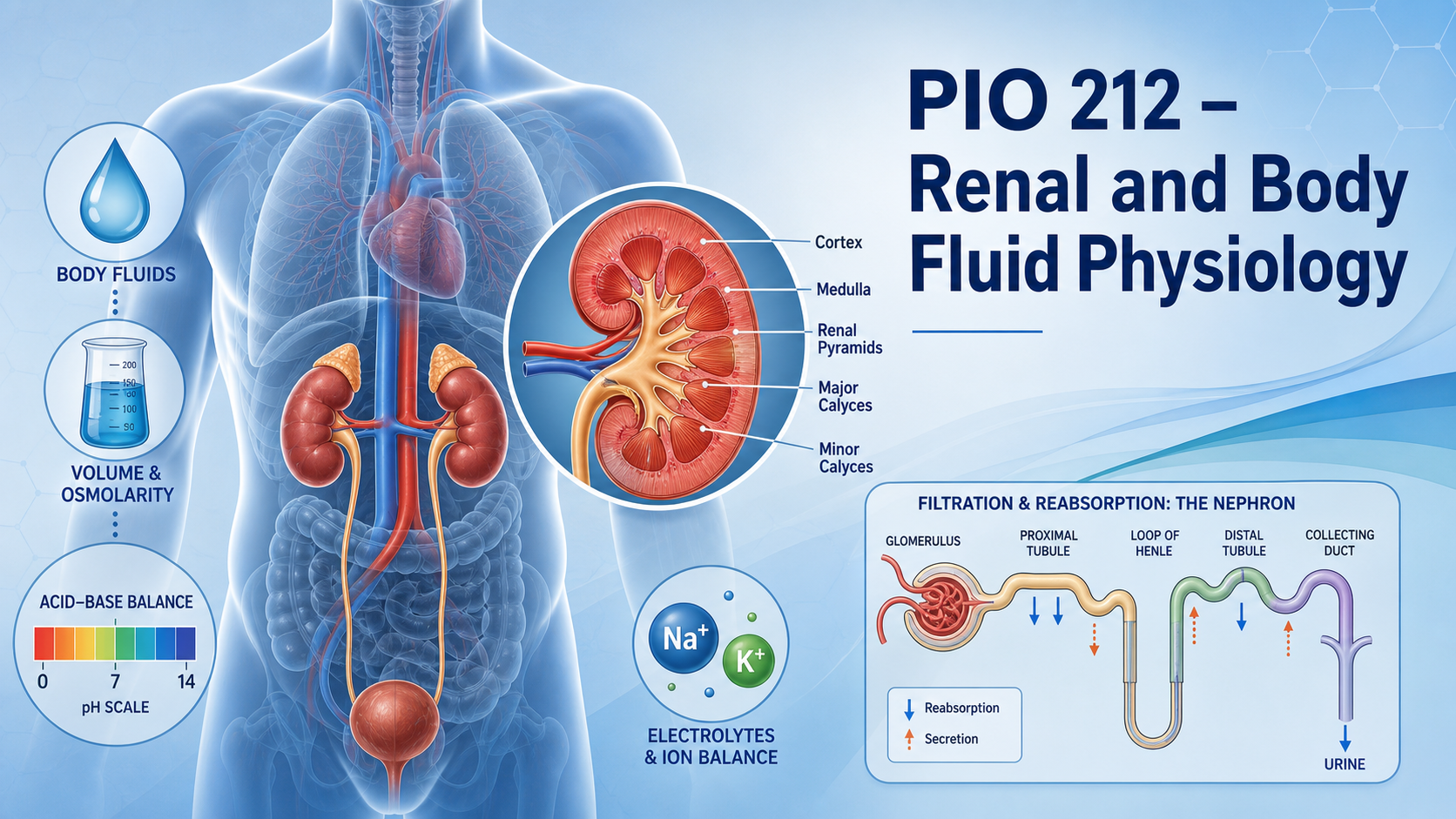
Renal and Body Fluid Physiology explains how the kidneys and body fluids work together to maintain a stable internal environment (homeostasis). Below is a concise course summary based on the outline you provided.
1. Structure of the kidney
Macroscopic: Each kidney has a cortex, medulla (with pyramids and papillae), calyces (minor and major), renal pelvis, hilum, renal artery, renal vein, and ureter. These structures collect, modify, and drain urine.
Microscopic: The functional unit is the nephron (renal corpuscle + tubule: PCT, loop of Henle, DCT, collecting duct) and associated vasculature (afferent/efferent arterioles, peritubular capillaries, vasa recta).
Ultrastructure: Specialized cells and membranes (fenestrated endothelium, glomerular basement membrane, podocytes with filtration slits, PCT cells with microvilli, ion pumps) form the filtration and transport barriers that allow selective handling of solutes and water.
2. Elements of renal function
Core processes that the kidney uses to form urine and regulate body fluids:
Filtration at the glomerulus produces a protein-free filtrate from plasma.
Tubular reabsorption returns needed water, electrolytes, glucose, amino acids, and bicarbonate to the blood.
Tubular secretion adds substances such as H⁺, K⁺, ammonia, and certain drugs into the tubular fluid.
Excretion is the final elimination of urine, containing metabolic wastes and excess substances.
3. Glomerular filtration, clearance, tubular transport, and renal blood flow
Glomerular filtration: Driven by hydrostatic and oncotic pressures (Starling forces); the glomerular filtration rate (GFR) is the volume of filtrate formed per minute and is a key index of kidney function.
Concept of clearance: Clearance is the virtual volume of plasma cleared of a substance per unit time; clearances of inulin and creatinine estimate GFR, while PAH clearance approximates renal plasma flow.
Tubular reabsorption and secretion: Occur via active and passive transport, co-transport and counter-transport, and are regulated by hormones (ADH, aldosterone, ANP, PTH) and neural factors.
Renal blood flow: Kidneys receive a large fraction of the cardiac output; autoregulation (myogenic mechanisms and tubuloglomerular feedback via the juxtaglomerular apparatus) maintains RBF and GFR relatively constant despite changes in systemic pressure.
4. Body fluid compartments and electrolyte balance
Compartments: Total body water is divided into intracellular fluid (ICF) and extracellular fluid (ECF: plasma, interstitial, and small transcellular volumes).
Composition: ICF is rich in K⁺ and phosphate; ECF is rich in Na⁺ and chloride. These distributions are maintained by cell membranes and Na⁺/K⁺ pumps.
Estimation: Indicator-dilution techniques use suitable markers to estimate total body water, ECF, plasma volume, and derive other compartments by calculation.
Electrolyte balance: Kidneys regulate Na⁺, K⁺, Ca²⁺, phosphate, and other ions through controlled reabsorption and secretion, thereby influencing volume status, osmolarity, and tissue excitability.
5. Buffers, pH regulation, and countercurrent system
Buffer systems: Bicarbonate, phosphate, and protein buffers (especially hemoglobin) minimize acute changes in pH.
Renal pH regulation: Kidneys reabsorb filtered bicarbonate, secrete H⁺, generate new bicarbonate, and excrete acid as titratable acid and ammonium, providing long-term control of acid–base balance.
Countercurrent system: The loop of Henle (countercurrent multiplier) creates a corticomedullary osmotic gradient through differential permeability to water and solutes; the vasa recta (countercurrent exchanger) preserves this gradient. This system allows the production of concentrated or dilute urine depending on ADH levels.
6. Water balance, electrolyte balance, and the kidneys’ role in homeostasis
Water balance: Intake (drinks, food, metabolism) must match losses (urine, sweat, feces, insensible losses). The kidney adjusts urine volume and osmolality, primarily via ADH, to maintain plasma osmolarity and volume.
Sodium and volume: Renal handling of Na⁺ (via aldosterone, ANP, sympathetic tone, and pressure natriuresis) is central to the regulation of ECF volume and blood pressure.
-Other homeostatic roles: Kidneys regulate blood pressure (renin–angiotensin–aldosterone system), red cell production (erythropoietin), calcium–phosphate metabolism (activation of vitamin D), and excrete metabolic and foreign substances.
7. Micturition and abnormalities of renal function
Micturition: Coordinated reflex and voluntary process involving bladder filling, detrusor muscle contraction, and sphincter relaxation, under spinal and higher center control.
Abnormalities: Include glomerular diseases, tubular disorders, obstructive uropathy, and chronic kidney disease; these can lead to altered GFR, proteinuria, haematuria, electrolyte disturbances, hypertension, edema, anemia, and bone disease.
This course, therefore, links detailed kidney structure to the mechanisms that control filtration, tubular transport, blood flow, body fluid compartments, acid–base balance, and urine formation, emphasizing how these processes maintain overall body fluid homeostasis.
- Teacher: Aliyu Muhammad