Course focus and learning goals
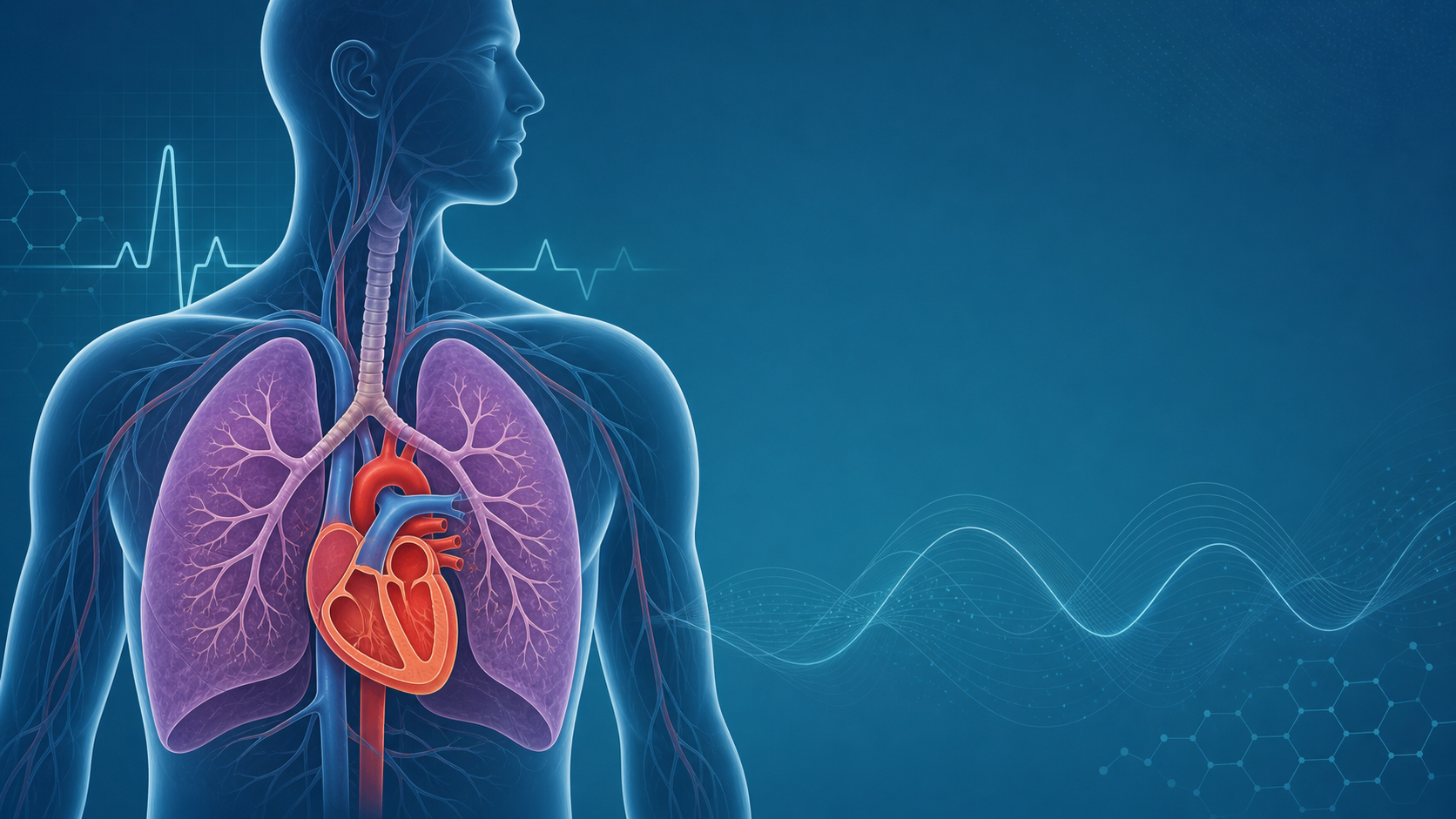
PIO 214 introduces the structure and function of the cardiovascular and respiratory systems and how they respond to physiological and pathological challenges. By the end, students should be able to explain cardiac electrical activity and the cardiac cycle, principles of hemodynamics and blood pressure regulation, and the mechanics, control, and gas‑exchange functions of the lungs, including their responses to exercise, hypoxia, hemorrhage, and shock.
Cardiovascular physiology
Heart structure and properties: Anatomy of the four‑chambered heart; right vs left heart; valves and septa; layers (pericardium, myocardium, endocardium). Functional properties of cardiac muscle include excitability, rhythmicity (SA node pacemaker, conduction system), conductivity (AV node, bundle of His, Purkinje system), and contractility (all‑or‑none law, staircase phenomenon, refractory periods).
Cardiac action potentials and ECG: Ionic basis and phases of the ventricular action potential and pacemaker potential; how ionic currents underlie automaticity and rhythmicity; relationship between cardiac electrical activity and the ECG in different leads.
Cardiac cycle and cardiac output: Phases of atrial and ventricular systole and diastole, timing of heart sounds, Starling’s law of the heart, and methods of measuring cardiac output (Fick principle, dye dilution, thermodilution).
Hemodynamics and blood pressure: Principles of laminar vs turbulent flow, determinants of vascular resistance, and the Starling capillary equation. Determinants of arterial pressure (cardiac output, heart rate, peripheral resistance, blood volume, vessel elasticity and diameter, viscosity); physiological variations, hypertension and hypotension, and short‑ and long‑term blood pressure regulation via neural (baroreceptor, chemoreceptor, cardiopulmonary, vasovagal reflexes), renal (ECF volume and renin–angiotensin), hormonal, and local mechanisms.
Exercise, hemorrhage and shock: Cardiovascular responses to acute and chronic exercise (changes in HR, stroke volume, cardiac output, blood pressure, and regional blood flow) and their long‑term adaptations and risks; physiology of hemorrhage (acute vs chronic, immediate and delayed compensatory responses) and classification and mechanisms of circulatory shock (hypovolemic, distributive, cardiogenic, obstructive).
Respiratory physiology
Functional anatomy: Upper and lower respiratory tracts, tracheobronchial tree, respiratory unit (respiratory bronchioles, ducts, sacs, alveoli), pleura and intrapleural fluid, and the respiratory membrane (type I and II pneumocytes, surfactant).
Lung mechanics and volumes: Mechanics of breathing (inspiratory and expiratory muscles, rib and diaphragm movements, changes in thoracic dimensions), lung compliance (factors increasing or decreasing it), and the role of surfactant in reducing surface tension and stabilizing alveoli. Static lung volumes and capacities (TV, IRV, ERV, RV, VC, FRC, TLC) and their physiological and pathological variations.
Pulmonary function tests: Dynamic measures such as forced vital capacity, FEV₁–₃, respiratory minute volume, maximum breathing capacity, and peak expiratory flow rate, and their diagnostic value in obstructive vs restrictive lung diseases.
Gas exchange and control of breathing
Pulmonary gas exchange: Diffusion of O₂ and CO₂ across the respiratory membrane; factors affecting diffusing capacity (surface area, thickness, solubility, molecular weight) and partial pressure gradients for gases from atmosphere to alveoli, blood, and tissues.
O₂ and CO₂ transport: Effects of the oxyhemoglobin dissociation curve on O₂ loading and unloading, and forms in which CO₂ is carried in blood (dissolved, bicarbonate, carbamino compounds).
Control of respiration: Nervous control via medullary (dorsal and ventral respiratory groups) and pontine (apneustic, pneumotaxic) centers; afferent inputs from higher centers, stretch receptors, irritant receptors, proprioceptors, baroreceptors, and chemoreceptors. Chemical control via central and peripheral chemoreceptors responding to changes in CO₂, H⁺ , and O₂.
Responses to hypoxia, altitude, exercise, and artificial respiration: Short‑ and long‑term adaptations to hypoxia (increased ventilation, sympathetic activation, erythropoiesis, capillary density), ventilatory and cardiovascular responses to exercise, and principles and methods of artificial respiration (mouth‑to‑mouth, mechanical ventilation, non‑invasive ventilation).
Overall, PIO 214 integrates cardiac and respiratory physiology to show how these systems maintain oxygen delivery, blood pressure, and homeostasis at rest and under stress, and provides the physiological basis for understanding common clinical problems such as hypertension, heart failure, respiratory disease, hypoxia, hemorrhage, and shock- Teacher: Aliyu Muhammad